
Introduction and significance of digital twins
For many real-world structures, a purely simulation-based finite element model is often limited by uncertainty in the applied loads. In practice, loads are rarely known precisely or remain constant over time. Examples include wind loading on wind turbine blades, aerodynamic drag and drift on aircraft wings, wave and current excitation on offshore structures, traffic loading on bridges, or natural excitations such as ambient vibrations and seismic microtremors. In historical bridges, in particular, the exact magnitude, distribution, and frequency content of traffic loads are often unknown and highly variable.
In these cases, digital twins informed by measured sensor data (like high quality, high sample rate Data Logger) can provide significantly more reliable results than a standalone FEM model. By recording acceleration directly from the structure using sensors, the actual dynamic response is captured, implicitly reflecting the true loads acting on the system. This measured response can then be used to drive or update the digital twin, enabling deformation, stress, and strain to be computed based on real operating conditions rather than assumed inputs. As a result, the predicted structural response more closely matches reality.
Another key advantage of sensor-informed digital twins is their ability to handle high-speed and high-frequency loading. Many mechanical and structural systems experience transient or rapidly changing loads that are difficult to model accurately using simplified load cases. Modern sensors are capable of capturing acceleration data at high sampling rates (Data logger with up to 20,000 Hz sample rate), allowing dynamic effects, resonances, and short-duration events to be measured with high fidelity. When this data is integrated into a digital twin, it enables a much more accurate representation of the system’s response under fast or complex loading scenarios.
Beyond improved accuracy, digital twins play a crucial role in predictive maintenance and risk mitigation. By continuously monitoring stress and strain within the digital twin, it becomes possible to detect critical conditions before material limits are reached. For example, in a historical bridge, a digital twin can be used to estimate stress accumulation under traffic loading and issue alerts before structural capacity is exceeded, allowing traffic to be restricted and preventing irreversible damage or collapse. Similarly, in industrial machinery, a digital twin can identify when stresses are approaching material strength and trigger alarms or automated shutdowns before catastrophic failure occurs.
Finally, when combined with machine learning techniques and physical AI, digital twins enable forecasting of structural response and degradation trends. By learning from historical sensor data and model outputs, these systems can estimate future behavior, anticipate damage progression, and optimize maintenance schedules. This approach not only improves safety and reliability but also reduces costly downtime and unnecessary maintenance interventions. Moreover, physical AI can autonomously interpret sensor data in real time and trigger preventive actions—such as adjusting loads, activating protective systems, or scheduling immediate inspections—closing the loop between sensing, modeling, and control.
The flowchart in Figure 1 summarizes how sensors and FEM can be combined to develop a digital twin for SHM, highlighting the potential of leveraging ML for predictive maintenance and Physical AI for automated monitoring.
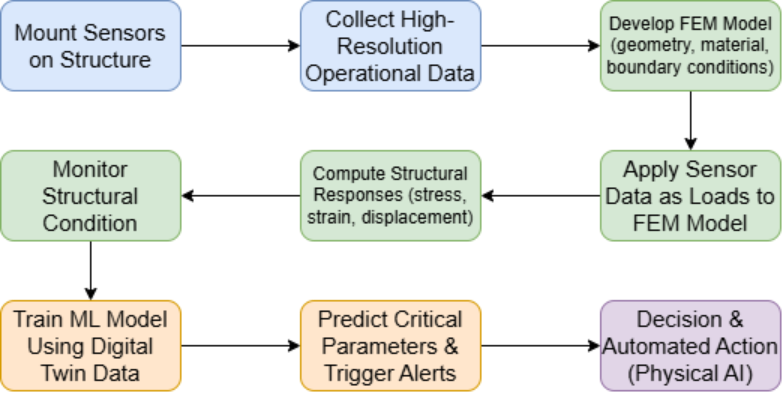
Figure 1. Workflow of a digital twin integrated with Physical AI: high-fidelity sensor data drives FEM simulations, which inform ML-based predictions. The system can autonomously detect anomalies and trigger preventive actions, closing the loop between sensing, modeling, prediction, and real-world control.
Physical Test Setup: A Scaled Cargo Crane Model
To demonstrate a practical, data-driven digital twin workflow, a small-scale structure resembling a cargo crane with a height of 20 cm and a span of 29.80 cm was 3D-printed as displayed in Figure 2.
|
|
|
|
|
|
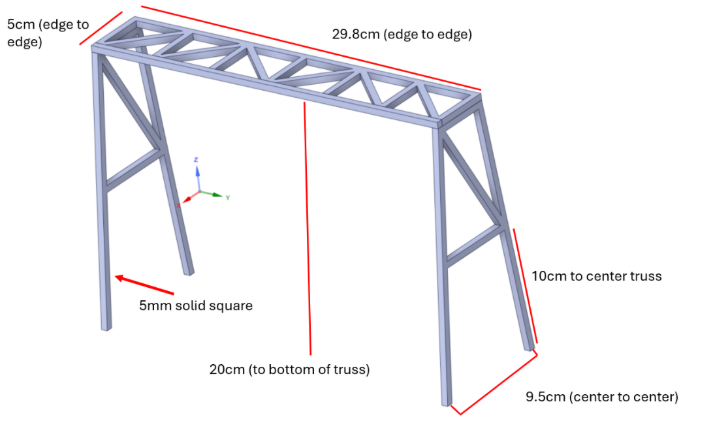
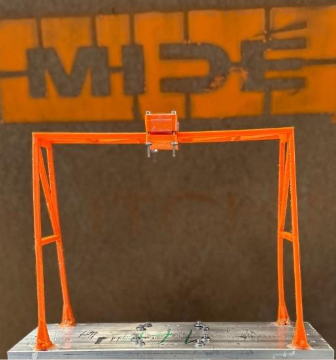
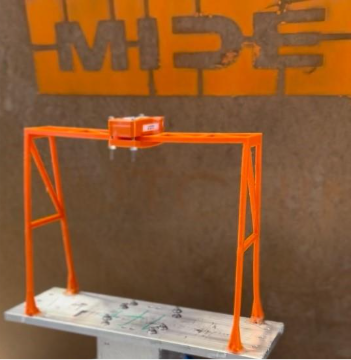
Figure 2. 3D-printed small-scale structure.
An data logger sensor was mounted at the mid-span of the crane’s horizontal truss beam, with the sensor’s Z-axis oriented normal to the ground, corresponding to the dominant direction of vertical motion (Figure 3). This location was selected to capture the maximum bending response and the most significant vibrational behavior of the structure. The sensor records acceleration data in three axes, providing a comprehensive view of the crane’s dynamic response. It should be noted that it could have worked for all locations on the beam, if rotation was to be included.
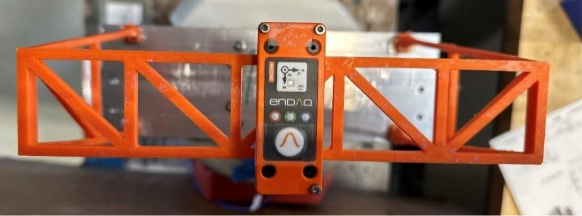
Figure 3. Mounted the data logger at the center of the structure span, with the Z-axis oriented normal to the ground.
As illustrated in Figure 4, the physical model was then subjected to controlled excitation using a shaker table. A sine sweep was run to find the natural frequency of 28 Hz. The system was then excited in a 2g sine wave over 20 seconds duration. During testing, the data logger sensor continuously recorded acceleration data, which serves as the primary input for constructing and updating the digital twin.
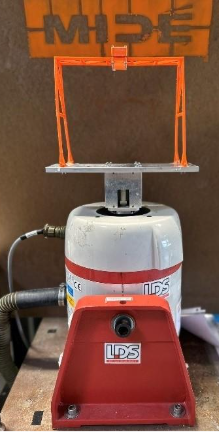
Figure 4. Structure with sensor mounted on the shaker for vertical excitation.
This experimental setup enables a direct comparison between measured physical behavior and finite element predictions. By combining high-fidelity sensor measurements with simulation models, the resulting digital twin accurately reflects the crane’s structural response, highlighting the advantages of a data-informed approach over purely simulation-based models.
Measuring Structural Response
Accurate measurement of structural response is a critical step in developing a reliable digital twin. In this experiment, the data logger sensor was used to record acceleration data during shaker excitation, capturing the dynamic behavior of the scaled crane under controlled loading conditions. Acceleration measurements provide high-resolution insight into structural motion and form the foundation for subsequent deformation and stress estimation.
Sensor orientation plays an important role in interpreting the recorded data. The data logger sensor was aligned such that its Z-axis was normal to the ground (as shown in Figure 3) and coincident with the dominant direction of vertical excitation. This alignment ensures that the primary bending response of the crane is captured directly. Proper axis alignment simplifies data processing and reduces uncertainty when mapping measured motion to the finite element model.
Sampling rate selection is another key consideration when measuring dynamic structural response. To accurately capture the crane’s vibrational behavior, the sampling frequency was chosen to be 4000 Hz which is sufficiently higher than the highest expected excitation frequency. This allows transient events, resonance effects, and high-frequency components of the response to be recorded without aliasing, ensuring that the measured data faithfully represents the true motion of the structure.
During shaker excitation, the data logger sensor continuously recorded acceleration time histories across all three axes for 20 seconds. These measurements capture both steady-state and transient responses, enabling the identification of dominant vibration modes and dynamic characteristics of the crane. The resulting acceleration data serves as the primary input for subsequent signal processing steps, where it is transformed into deformation and used to drive the digital twin.
From Acceleration to Deformation
Acceleration measurements provide the dynamic information needed to build a digital twin, but to predict structural response such as stress and strain, we need displacement or deformation. This section explains how the raw acceleration data from the data logger sensor is transformed into relative deformation.Signal Processing Overview
Raw acceleration signals often contain sensor noise, bias, and low-frequency components that can distort integration. A band-pass filter is applied to isolate the relevant frequency range, removing both slow drift (e.g., gravity projection or sensor bias) and high-frequency noise, while preserving the structural vibrations of interest.
Filtered acceleration signals are integrated once to obtain velocity and integrated a second time to estimate displacement. To mitigate low-frequency drift commonly introduced during double integration, several precautions are applied. First, the acceleration signals are band-pass filtered to remove both DC bias and high-frequency noise (read “Preprocessing Vibration Data for Machine Learning” blog for more details on signal processing). The time history is then divided into multiple fixed-duration windows (chunks), and integration is performed independently within each chunk with zero initial velocity and displacement.
Within each chunk, any residual drift in the displacement signal is further removed by subtracting a best-fit linear trend. This chunk-wise integration strategy prevents error accumulation over long time histories and ensures numerical stability, as shown in Figure 5.
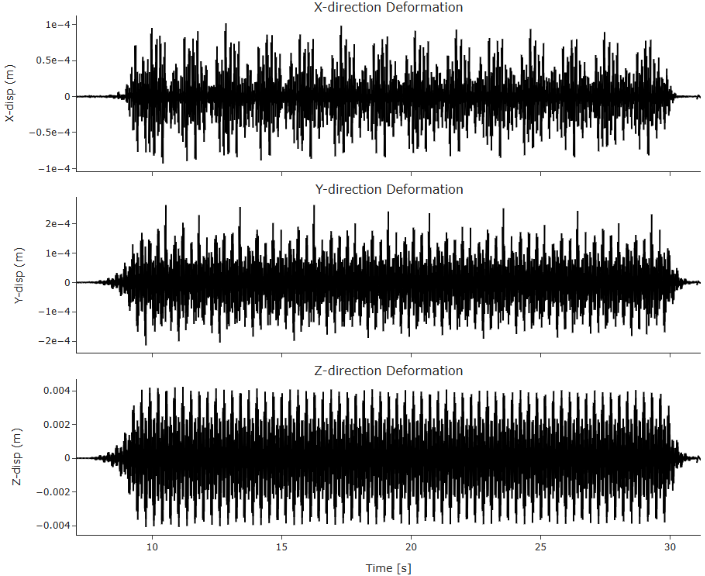
Figure 5. Mid-span displacement in X, Y, and Z directions, obtained by double integration of sensor acceleration.
The final output is the peak relative displacement in each spatial direction (X, Y, and Z) per chunk, as shown in Figure 6.
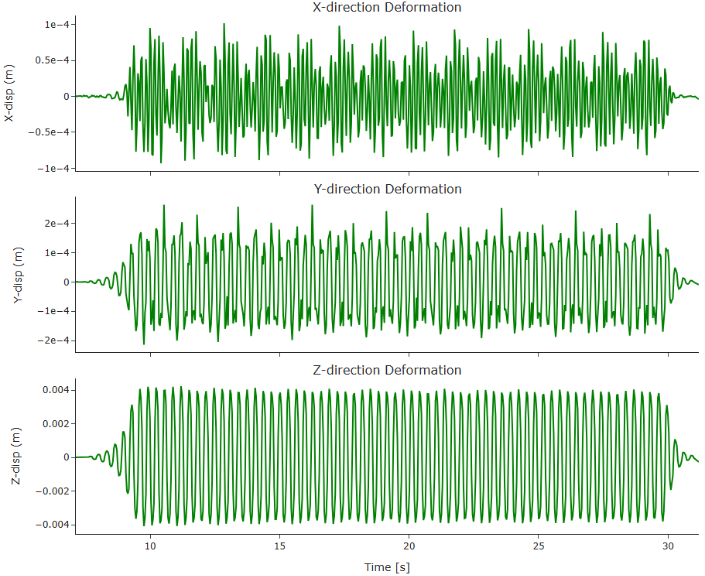
Figure 6. The resulting displacement represents relative structural deformation.
Note: More advanced state-estimation techniques, such as Kalman filtering or complementary filtering, can be used to convert acceleration measurements into displacement while further reducing noise and integration drift, especially for long-duration signals or low-frequency motion. In this work, classical double integration with band-pass filtering and chunk-wise drift correction is adopted for the sake of simplicity, transparency, and ease of implementation.
Creating the Digital Twin: FEM Model of the Crane
- Geometry and material modeling – The model consists of 5mm square sections which create a simplified gantry crane design. The CAD model was 3D printed using ABS material. The print was done with 100% infill as any infill percentage would not be able to be modeled in the finite element analysis properly. For the finite element analysis, the material properties of ABS (Youngs modulus of 348 ksi and poison ratio of 0.41) was used.
- Boundary conditions matching the physical setup – The physical system had two, #2 bolts at each of the feet used to secure the “A frames” to the aluminum plate. Along with the bolts, some 5-minute epoxy was also added for additional strength and to prevent any vibrational chatter during the test. For the FEA, fixed boundary conditions were applied to the feat of the “A frame”. The aluminum plate was not modeled into the FEA as it was substantially stiffer and would not vibrate at the low frequencies used to excite the structure.
Stress and Strain Monitoring in the Digital Twin
One of the most important aspects of a digital twin model is the ability to see the operational stress and strain that was put on the structure. These operational loadings can then be used by the engineers to better predict the characteristics of the structure. In the crane example, when the displacements in the FEA match those seen on the structure and proper boundary conditions and material properties are applied, the stress and strain in the model accurately reflect reality. By placing the displacements into the FEA, stress and strain values can then be found at any location, not just where sensors are located, as shown in Figure 7. It should be noted that the stresses predicted by the FEA are lower than the material strength, which is consistent with the experimental observations, as no cracks or structural failure were detected during testing.
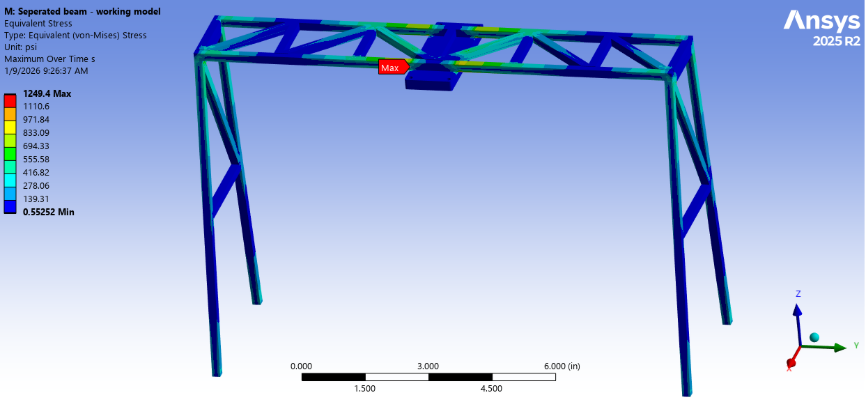
Figure 7. Von Mises stress distribution obtained from finite element analysis.
This allows the engineers to better predict the failure modes of the entire structure and when these might happen. For example, if the crane was rated for so many years of service under “normal” conditions but the sensor picked up an extreme loading event, the engineers could reevaluate and reduce the crane life accordingly or make repairs as necessary.
The video below demonstrates the experimental vibration test on the small-scale cargo crane (top left), alongside its FEM model subjected to the same acceleration profile recorded by the data logger (middle). The bottom section shows the Von Mises stress distribution during vibration. The acceleration time history is displayed at the top right of the video.